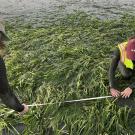
Invisible in the clear afternoon sky, the moon tugged the tidal channel’s brackish waters towards the Pacific Ocean. It drew them out slowly, languidly, the water’s surface eddying and rippling in the sunlight. Elisabeth Sellinger stood shoulder-deep in the withdrawing water. She...READ MORE
Palm trees in Alaska, crocodiles in Wyoming: Fossils show that Earth’s temperature has changed over hundreds of millions of years. Now a new study co-led by the Smithsonian and the University of Arizona, with Professor Isabel Montañez of the UC Davis Department...READ MORE
The inaugural Summa and Awwiller Postdoctoral Fellow of the Department of Earth and Planetary Sciences at UC Davis, Dr. Xiaochuan Tian, will break ground in research of our home planet’s topography evolution and geohazard mitigation starting this October. Investigating...READ MORE
New results from China’s Chang’e 5 lunar samples returned to Earth provide evidence for active volcanoes on the Moon as recently as 120 million years ago. Previously, scientists had thought that any activity with magma (molten rock) rising to the Moon’s...READ MORE
The Department of Earth and Planetary Sciences proudly highlights the recent publication of Dr. Elizabeth Grant, an alumna of our department. Her paper, "Shallow Storage of the Explosive Earthquake Flat Pyroclastics Magma Body...READ MORE
After a year of planning, UC Davis students completed their first day of teaching in Escuela Secundaria Estatal Modesto Sánchez Mayón in Loreto. This program involves 2 weeks of teaching water science, with the goals of promoting education...READ MORE
How do we study the evolution of microbial life on early Earth? In the hundreds of millions of years that followed the oxygenation of our planet, Earth’s surface was transformed by microbial evolution, diversifying the ways in which...READ MORE
In the latest issue of the National Academy of Sciences' PNAS journal, Professor Kari Cooper's research on "crystal clocks" reveals exciting advancements in predicting volcanic eruptions. By studying tiny mineral crystals embedded in volcanic mountains...READ MORE
From Mungo to Wouri to Dibamba, Cameroon’s rivers converge near the urban center of Douala, creating the tropical mangrove habitat known as the Wouri estuary. Immersed in this essential ecosystem for biodiversity, Sunjo Claris, a Ph.D. student in...READ MORE
The Department of Earth and Planetary Sciences is excited to highlight the pioneering research of Ph.D. student Luis Erick Aguirre Palafox, in his groundbreaking study on paleosols. By applying uranium-lead dating (U-Pb) techniques, his work...READ MORE
When Susann Pinter’s crochet exhibit “Project Ecosystem” debuted on Picnic Day at UC Davis earlier this year, it mesmerized thousands with its intricate and unique depiction of marine life and ecosystems. This week, Ms. Pinter, the Academic Coordinator for...READ MORE
During a recent Davis Science Café, Professor Tessa Hill of UC Davis Earth and Planetary Sciences highlighted that seagrass meadows play a crucial role in storing carbon, thereby protecting oceans from increased acidification and bolstering marine life resilience...READ MORE
Following three years of dedicated leadership, Professor Kari Cooper is stepping down from her position as Chair of the Department of Earth and Planetary Sciences at UC Davis. Assuming the position is Professor Magali Billen who has spent two decades in the department...READ MORE
Anjelica Guerrier, a Ph.D. student in the Department of Earth and Planetary Sciences, working under Dr. Kari Cooper, dive into the cryptic world of magma chambers. Through meticulous analysis of erupted volcanic rocks and and crystals, they aim to shed...READ MORE
Professor in the Department of Earth and Planetary Sciences, Dr. Magali Billen, is building a digital twin of the Earth using aggregate data from seismic research. The model would predict how tectonic plates shift over time and where stress builds up...READ MORE