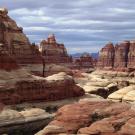
Did Al Capone have an outpost in the Everglades? How do inanimate stones manage to slide across the flat landscape of Death Valley National Park? And what happened to the lost colony of Roanoke? For UC Davis alum and outdoor writer Mike Bezemek, these tantalizing...READ MORE
Claris Nyuysoni Sunjo knows firsthand the dangers of living in a place with unsafe drinking water. Growing up in Mbah in Cameroon, Sunjo was once rushed to the hospital and even lost a friend due to waterborne illnesses. Those experiences triggered a desire within her. She...READ MORE
Take a deep breath in. Hold it in for a second. And now, let it out. While that simple, measured way of breathing can instill calm in us, it also connects us to our home planet. “That oxygen that you just absorbed comes from billions of years of evolution of photosystems...READ MORE
We are thrilled to announce that Distinguished Professor Dr. Isabel Montañez of the Department of Earth and Planetary Sciences has been awarded the 2025 Athena Award in Academic Leadership by EDGE in Tech at the University of California...READ MORE
We are thrilled to announce that Dawn Sumner, Distinguished Professor in the Department of Earth and Planetary Sciences, has been elected as a Fellow of the American Association for the Advancement of Science (AAAS). This prestigious recognition honors her...READ MORE
Imagine a catastrophic earthquake shaking California's coastline, followed by landslides that block vital roads. Or a rainstorm hitting a region devastated by wildfires, triggering debris flows of unreinforced material into densely populated areas. In a world where geohazards often occur...READ MORE
On the first floor of the Earth and Physical Sciences Building, tucked away amongst the classrooms and labs, is a space that contains remnants of Earth’s ancient past. Large cabinets line the sides of the hall-like room, the drawers of which are labeled with different geological periods. The names...READ MORE
Our planet’s history is one of extreme climate cycles that repeat across time, with insights into the Earth’s previous responses still accessible today. This is part of what Isabel Montañez is working to understand — what these moments might teach us about our changing climate and future climate...READ MORE
The McMurdo Dry Valleys don’t look like they belong in Antarctica. Largely devoid of snow, the landscape is mostly dirt and rock. When explorer Robert Falcon Scott trekked the area in 1903, he referred to it as “the valley of the dead.” But that name is a misnomer. While life may not be evident...READ MORE
Alyssa Griffin likens the experience of scuba diving to a sensory deprivation tank. Beneath the water, weightlessness envelops the body and sounds are amplified. The hiss of the regulator chimes like a metronome, mixing with the natural soundscape produced by ocean creatures and processes...READ MORE
Dr. Amanda Thomas, a visiting professor in the Department of Earth and Planetary Sciences at UC Davis, has just been awarded the Presidential Early Career Award for Scientists and Engineers (PECASE) — one of the highest honors the U.S. government can bestow on early-career scientists. Presented by President Joe Biden...READ MORE
On March 11, 2011, a 9.1 magnitude earthquake hit just off the northeast coast of Honshu, the most populated island of Japan. The seismic event triggered a tsunami with a wave height of more than 130 feet. The natural disaster left more than 18,000 people dead. According to the U.S. Geological Survey,...READ MORE
An international team of geoscientists led by a volcanologist at Rutgers University-New Brunswick and including Maxwell Rudolph, associate professor in the UC Davis Department of Earth and Planetary Sciences, has discovered that, contrary to present scientific understanding...READ MORE
Looking at a jellyfish is like looking into the ancient past. Survivors from the late Precambrian Era, these organisms lived in an environment completely alien to the wide swath of modern Earth. They thrived during a time when the waters of our planet were largely anoxic, the lack of oxygen making them...READ MORE
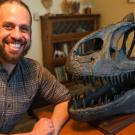
The Department of Earth and Planetary Sciences is excited to announce the installation of our stunning T-Rex fossil head in the lobby of the Earth and Physical Sciences building! This remarkable replica, cast from the famous "Black Beauty" fossil at the Royal Tyrrell Museum, was made possible...READ MORE